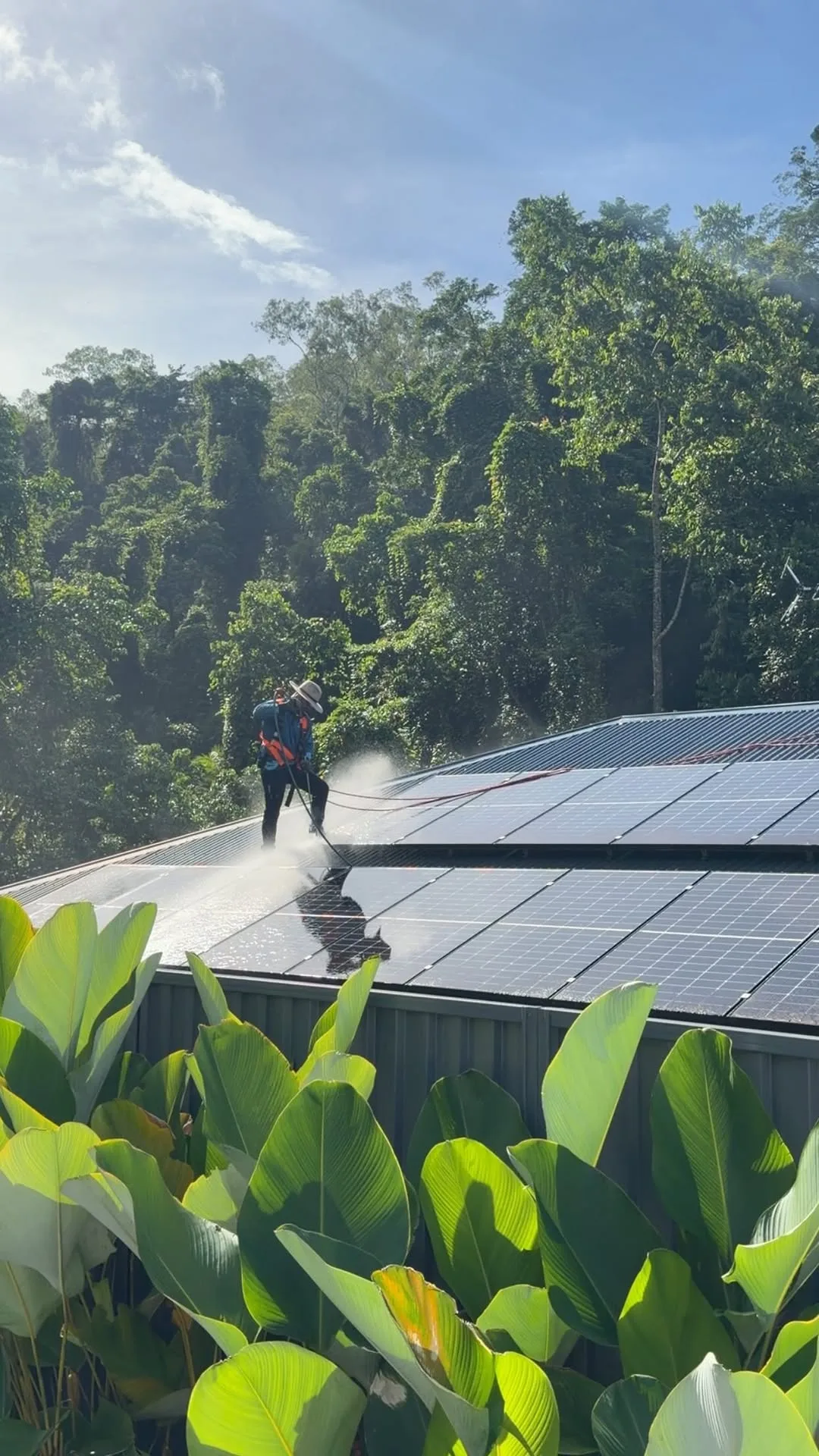
YOUR PANELSARE QUIETLYUNDERPERFORMINGAND NOTHINGTELLS YOU.
Dust, salt haze and bird droppings sit on solar glass like an insulating blanket. Washed off with pure de-ionised water and nothing else, so there is no film left behind to attract the next layer.
THE ONLY FAULTYOUR INVERTERWON’T REPORT.
A solar array degrades in a way that is almost impossible to notice from inside the house. There is no alarm and no error code — output just drifts down, a little each month, as the glass loses transparency. By the time the drop is obvious on a bill it has usually been happening for a year or more.
Far North Queensland is unusually hard on panels. Cane dust and red soil in the dry, salt haze anywhere near the coast, and a wet season that leaves mineral spotting behind every time a shower dries on the glass rather than rinsing it. Bird droppings are worse again, because they don’t reduce output evenly — they shade individual cells, and a shaded cell drags the whole string down with it.
The industry figure for what a genuinely dirty array gives back after a proper clean sits around a quarter of lost output. That is the number worth knowing, because it is the difference between a system paying for itself on schedule and quietly running behind.
“Solar panels get no chemicals at all: pure de-ionised water only.”
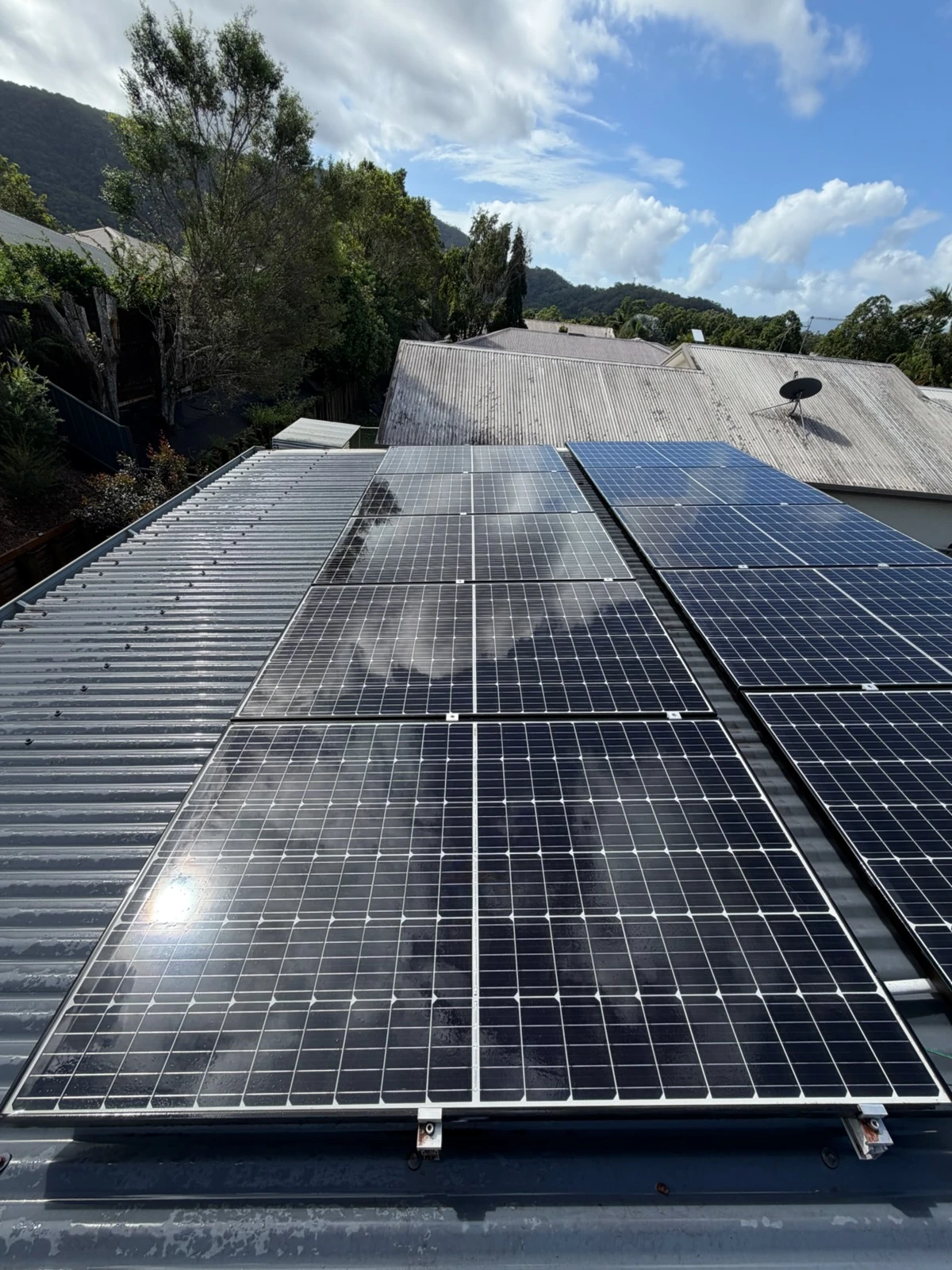
PURE WATER.SOFT BRISTLES.NOTHING ELSE.
Ordinary water is full of dissolved minerals, and when it dries on glass those minerals stay behind as spotting — which is precisely the problem you were trying to solve. De-ionised water has had them stripped out, so it dries on the panel and leaves nothing at all.
It also cleans more aggressively than tap water does, chemically speaking: pure water is unstable and actively pulls dissolved solids off the surface it touches. That is what makes it possible to clean solar glass properly with no detergent whatsoever — which matters, because detergent residue is both a warranty question and a magnet for the next fortnight of dust.
The brushes are non-abrasive and run on carbon-fibre water-fed poles from ground level. Nobody needs to walk on your array to clean it.
- Water
- Multi-stage de-ionised pure water
- Chemicals
- None — zero detergent on panels
- Brushes
- Non-abrasive, panel-safe
- Access
- Water-fed poles from the ground where possible
- Residue
- Dries spot-free, nothing left behind
- Best cadence
- Annually, or twice yearly near cane or coast
WHAT THE SOLARCLEAN COVERS.
Residential rooftop arrays
Standard household systems, cleaned from the ground wherever the pitch and height allow.
Commercial & shed arrays
Larger installations on sheds, warehouses and community buildings.
See the pageGround-mount systems
Ground arrays, which pick up far more soil splash than rooftop ones.
Panel frames & rails
Washed down with the glass, since that is where lichen takes hold first.
Bird dropping & lichen removal
The shading kind of soiling, which costs disproportionately more output than dust.
Roof clean at the same visit
Panels and roof in one visit, sequenced so neither undoes the other.
See the pageWHAT WE DON’TTOUCH.
Electrical work of any kind
Inverters, isolators, wiring and connections belong to a licensed electrician. We clean glass.
Panel repair or replacement
Cracked glass, delamination and hot spots get photographed and handed to your installer.
Solar guards & bird mesh
Fitting exclusion mesh under panels needs a qualified installer. We’ll clean what’s under there where we can reach it.
Output testing or performance reports
We don’t measure your system. Your inverter app and your installer do that properly.
Walking on arrays
We don’t stand on panels, which is why the poles exist.
Arrays above three storeys
The same height ceiling as everything else here.
WHAT GETSCHECKED FIRST.
A short list, and one of them is the manufacturer’s own instructions.
Panel manufacturer guidance
Some manufacturers are specific about cleaning method. Pure water and soft brushes satisfy essentially all of them.
Time of day
Panels are cleaned cool, not in the middle of a Cairns afternoon. Cold water on hot glass is a genuine thermal-shock risk.
Visible damage
Cracks, delamination, discoloured cells and heat marks photographed before anything is washed.
Cabling & mounting
Loose cabling, sagging conduit and corroded rail feet noted for your installer.
What’s living underneath
The cavity under an array is prime nesting real estate. What we find gets photographed.
Roof access & pitch
Whether the array can be reached from the ground on poles or needs a roof approach.
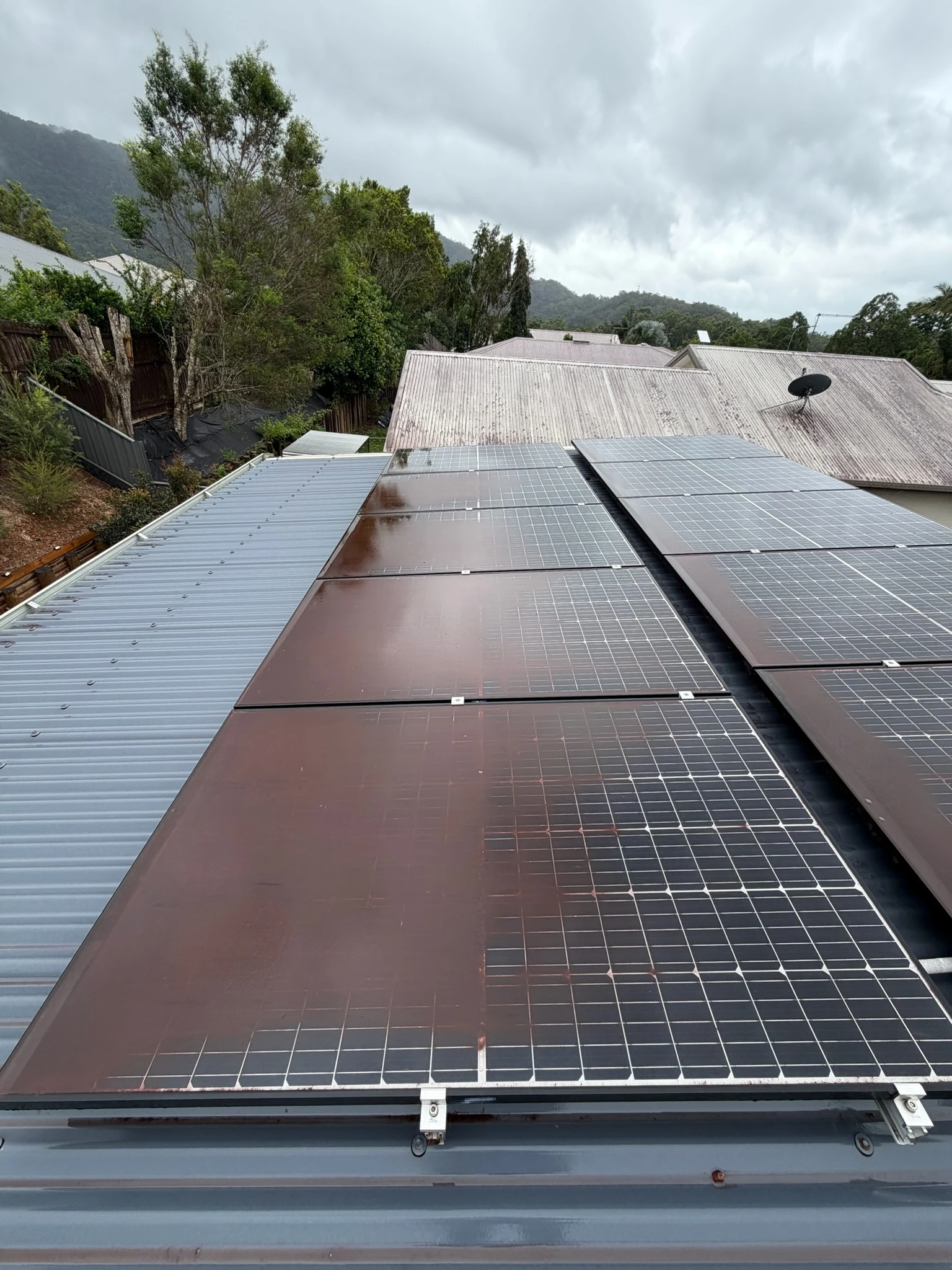
Tropical dust and salt haze on residential panels, washed off with pure water and nothing else.
HOW A SOLARCLEAN RUNS.
Quick, quiet, and usually done from the ground while you carry on with your day.
- 01
Tell us the panel count
Roughly how many panels, single or double storey, and a photo of the array if you can get one.
- 02
The measure
Panel counts and roof pitch confirmed from satellite imagery, with the access approach worked out at the same time.
- 03
The quote
In writing, naming the array and whether it is a pole clean or a roof access job.
- 04
Inspection & before photos
Glass, frames, cabling and anything nesting underneath all photographed first.
- 05
The wash
Pure de-ionised water and soft brushes, panels and frames, left to dry spot-free on their own.
- 06
After photos, then the invoice
Plus photos of anything on the array your installer should look at.
THE THINGSPEOPLE ACTUALLYASK.
Still not covered? Ring Blake on 0495 090 010. Enquiries are answered the same day.
Does cleaning my panels actually make a difference?
On a genuinely dirty array, yes, and the industry figure sits at around a quarter of lost output recovered. On panels cleaned a few months ago, far less. If you are not sure which you have, a photo of the array usually settles it.
Will it void my warranty?
Pure water with non-abrasive brushes is the method panel manufacturers themselves point to. The things that put warranties at risk are abrasive pads, harsh detergents and people walking on the array — none of which happen here.
Why no detergent?
Because anything you put on the glass has to come back off it, and whatever doesn’t becomes a film that holds the next round of dust. De-ionised water cleans without leaving residue and dries spot-free on its own.
How often should panels be cleaned in Cairns?
Once a year suits most systems. Near cane country, unsealed roads or the coast, twice a year is more realistic — dust and salt build up considerably faster than they do inland.
Do you need to get on the roof?
Usually not. Water-fed carbon-fibre poles reach most residential arrays from the ground, which is safer for everyone and better for the panels. Steeper or higher installations may need roof access, and that gets confirmed at quote stage.
OFTEN BOOKEDAT THE SAME TIME.
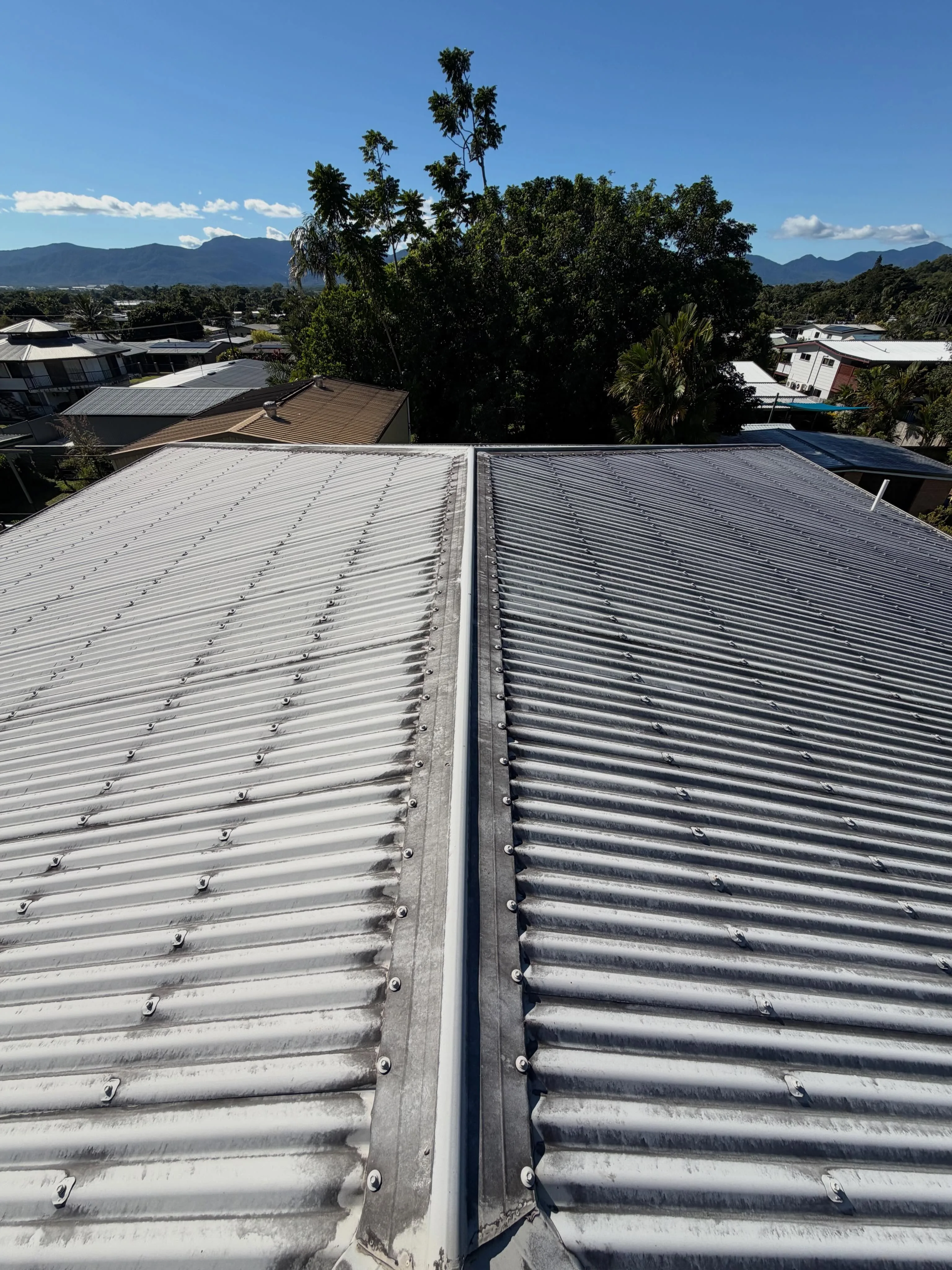
FOUR TAPS.ONE NUMBER.NO PHONE CALL.
Tap what you’ve got and the estimate builds as you go. Blake measures the real thing before it becomes a fixed price, and every enquiry is answered the same day.